Start with the comparison your guests will enjoy
For a private Champagne tasting, decide what guests will compare before asking for a bottle list. An introduction for curious friends, a focused flight for collectors, and a short client toast need different amounts of explanation, table space, and service. Write one sentence about the experience you want, then choose the wines and room around it.
Champagne comes from Champagne, France. A flight containing Champagne alongside Cava, Franciacorta, or another sparkling wine is a sparkling-wine comparison. Both can be useful themes; name the scope clearly on invitations and proposals so guests know what they are attending.
This guide is for an event with your own guest list. If you want individual seats at a public class, check the organizer's current calendar and ticket terms. If you want a private host and service plan, use the Champagne event page to request a proposal.
Give the flight one clear question
Use the table as a planning worksheet, not a promised lineup. Three wines are a workable starting point for the illustrative agenda below; the host should adjust the flight to the group's interest, time, and budget. A memorable comparison does not require every bottle to be rare.
The names on a Champagne label describe different things. Blanc de Blancs identifies white grape varieties, while Blanc de Noirs identifies red grape varieties. Brut and Extra Dry describe sweetness categories; Extra Dry is the sweeter category. A vintage identifies a harvest year. Ask the host which variable the flight explores, and which other differences may influence what guests notice.
| Question for the group | Possible comparison | What to confirm |
|---|---|---|
| Which style do we enjoy? | Three Champagne cuvées with contrasting profiles | The reason for each selection and a short, beginner-friendly introduction. |
| What changes when the blend changes? | A Blanc de Blancs, a Blanc de Noirs, and a blended cuvée | Producer, vintage, and sweetness may also differ; avoid claiming this isolates grapes alone. |
| How does Champagne compare with another sparkling wine? | Champagne plus clearly identified wines from other origins | Label each origin accurately and keep the price and serving context visible. |
| Which wine works with the food? | A small Champagne flight with one or two bites | The final menu, ingredients, serving order, and separate catering responsibility. |
Calculate bottles for each wine, not just the whole event
Start with the number of guests actually requesting that wine and the planned sample size. For each cuvée, divide guests × sample millilitres by bottle millilitres, then round up to whole bottles. Repeat the calculation for every wine. An extra bottle of one cuvée cannot complete a missing comparison of another.
The examples below use 750 ml bottles and 50 ml samples only to demonstrate the arithmetic. They are not a drinking target, a fixed package, or a complete purchase order. Guests may skip or leave any sample. Water, zero-proof drinks, host samples, spills, foam, bottle condition, and any later toast require separate decisions.
| Tasting participants | Wine needed per cuvée | Whole bottles per cuvée | Three-cuvée flight |
|---|---|---|---|
| 12 | 12 × 50 ml = 600 ml | 1 × 750 ml | 3 bottles total |
| 24 | 24 × 50 ml = 1,200 ml | 2 × 750 ml | 6 bottles total |
| 30 | 30 × 50 ml = 1,500 ml | 2 × 750 ml, with no margin | 6 bottles mathematically; no allowance for service loss |
Plan the cold space and glass footprint together
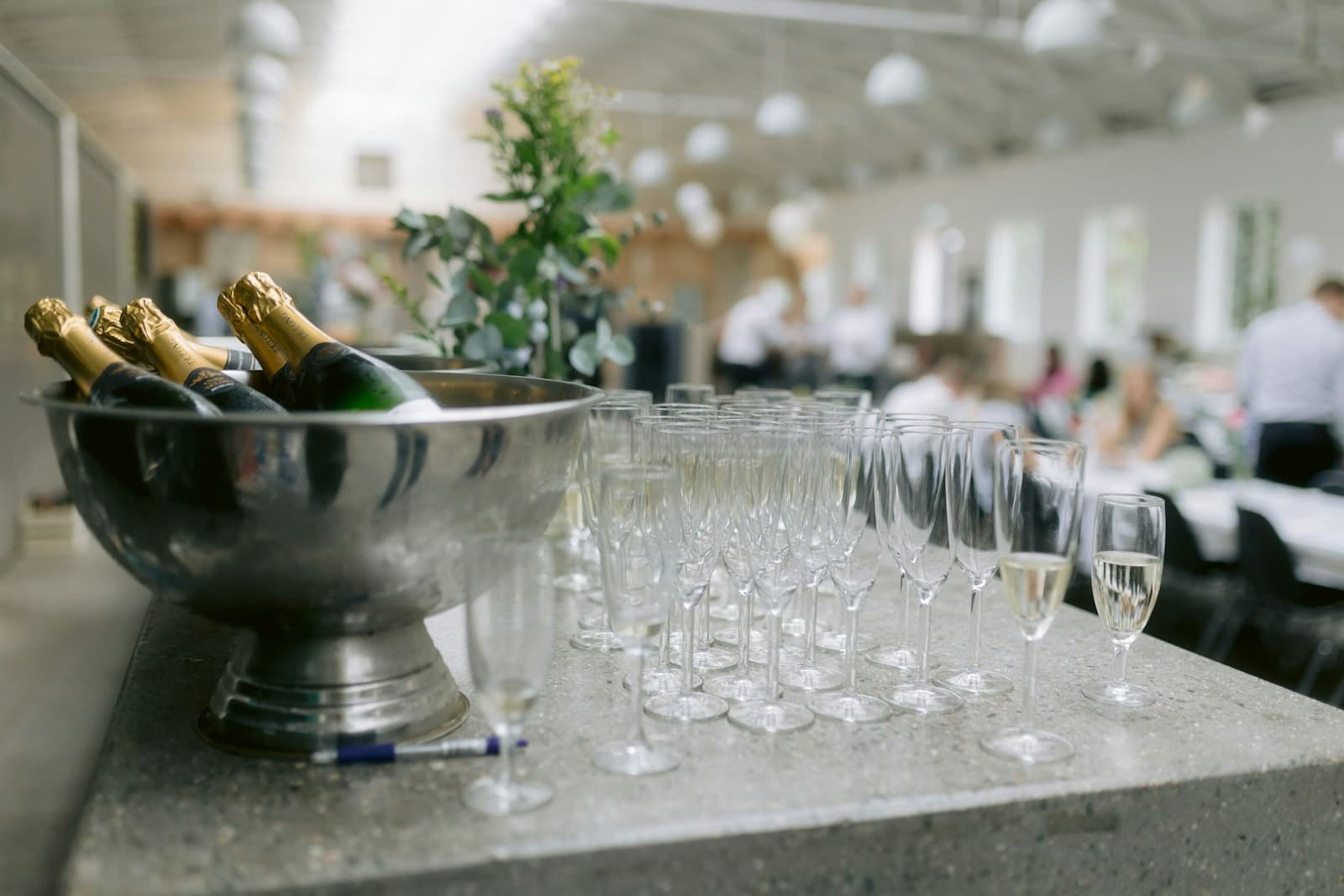
Comité Champagne recommends serving at about 8–10°C and using a tall, rounded glass that narrows at the top to express aromas. For the event brief, translate that into a chilled-bottle plan and an actual glass choice. An ice bucket in a photograph does not establish enough cooling capacity for your group.
Decide between side-by-side comparison and sequential service. In a hypothetical 24-person flight, three glasses per tasting participant means 72 tasting glasses on the tables before water glasses or replacements. Sequential service can use less table space, but guests cannot revisit all three wines together, and the host must agree how glasses are refreshed or replaced.
Ask where bottles will be held before and during service, who brings ice and buckets, and where meltwater goes. Keep wet service equipment away from guest circulation and electrical equipment. Assign glass collection and breakage handling to the service team; do not leave them as unpriced work for the party host.
- Count the tasting places, water glasses, service glasses, and agreed replacement stock separately.
- Measure table space with the actual glasses, tasting notes, food, and water in place.
- Name a person responsible for receiving and chilling the delivery before guests arrive.
- Confirm a stable service surface, water access, clearing route, and collection point.
Use a 75-minute agenda to test the room
This is a hypothetical seated tasting for a group arriving together. It is an original planning example, not a report of a WineTasting.NYC event or a standard package. Setup, chilling, and cleanup happen outside these 75 guest-facing minutes and need their own access windows.
| Minutes | Guest experience | Host or service check |
|---|---|---|
| 0–10 | Arrival, water, food, and an introduction to the question | Confirm participation choices and the serving sequence. |
| 10–25 | First wine and a short aroma discussion | Pour agreed samples and give guests time to describe preferences. |
| 25–40 | Second wine and a comparison | Explain the meaningful differences without turning them into a guessing test. |
| 40–55 | Third wine, with a food comparison if arranged | Coordinate the bite and allow guests to opt out. |
| 55–65 | Questions and a return to the comparison | Use notes or remaining samples; do not assume automatic refills. |
| 65–75 | Favorite discoveries, final questions, and transition | Confirm the service finish and start the agreed glass collection. |
Make food and zero-proof participation part of the same brief
Choose whether food is a pairing exercise, a light accompaniment, or a separate meal. Comité Champagne's pairing reference organizes suggestions by both dish and Champagne style; the menu should follow the selected wines and guests' requirements rather than a universal pairing rule.
For a simple planning exercise, ask the host and caterer to propose one bite tasted alongside two wines, then invite guests to compare their preferences. Name the portion, ingredients, dietary alternatives, delivery time, and clearing responsibility. Food is not included merely because a page mentions pairings.
Give non-drinking guests a useful role in the conversation: aroma descriptions, food preferences, or a parallel zero-proof comparison if arranged. Ask about dietary and ingredient needs privately during planning. Let guests decline a pour without explaining why, and make water and zero-proof options easy to find.
Resolve NYC room permissions before buying the flight
An office, home, restaurant private room, and rented event space can have different rules for outside wine, vendors, and service. Get the room's written requirements and ask the proposed operator who is responsible for alcohol supply and any applicable licensing or permits. A private guest list alone does not settle those questions.
The New York State Liquor Authority publishes different permit routes and eligibility conditions. Use its current guidance with the actual venue and operator; do not assume one permit applies to every tasting. Confirm the person responsible and the deadline before committing to bottles, catering, or rentals.
Also walk through the guest journey: entrance, elevator or step-free route, seating, restroom access, sound level, and any accommodation requests. NYC's accessible-event guidance is a useful starting point. A seated tasting needs a layout that remains navigable after chairs, bags, service equipment, and extra glasses are in place.
Send one brief that can produce comparable proposals
A useful request can be incomplete without being vague. Mark unresolved items as open decisions and name who will answer them. Compare quotes against the same brief, especially when one includes wine and rentals and another only includes a host.
WineTasting.NYC operates events directly and also refers requests to independent hosting partners. Before you book, your proposal should identify the event operator, contracting party, payment recipient, and who supplies and serves the wine. A referral does not make the partner's venue, bottles, or staff our own.
| Brief field | What to write |
|---|---|
| Occasion and guest list | Purpose, total attendees, expected tasting participants, and zero-proof requests. |
| Date and room | Date window, NYC location, venue status, access hours, and room contact. |
| Flight question | Champagne-only or mixed sparkling; one question guests should explore; any requested bottles. |
| Service shape | Seated, short guided segment, or station; guest-facing duration and arrival pattern. |
| Budget boundary | Working total and what it must cover: wine, host, staff, glassware, food, delivery, and room. |
| Supply responsibilities | Who buys and receives wine, chills it, brings rentals, serves, clears, and handles leftovers. |
| Booking conditions | Operator and contracting party; payment recipient; approval deadline; substitution and cancellation terms. |
Quick answers
Wine tasting planning FAQ
How many Champagnes should we compare?
Start with the question and available time. The sample agenda uses three wines across 75 minutes, but it is an illustration, not a required package. Ask the host to recommend a flight your guests can discuss without rushing.
How many bottles do I need for 12 people?
At an illustrative 50 ml sample, 12 participants need 600 ml of each wine. One 750 ml bottle per wine covers that arithmetic, or three bottles for three wines, before any separately agreed service allowance, reserve, or toast. The operator should confirm the final order.
Do we need a separate glass for every wine?
Separate glasses let guests revisit wines side by side. Sequential service can take less table space, but the host must define glass replacement or refreshing. Count water glasses and agreed replacements separately.
Can we include other sparkling wines?
Yes, if that is the chosen theme. Describe the event as a Champagne and sparkling-wine comparison, and identify each wine's origin accurately. The actual bottles and availability belong in the proposal.
Can we supply bottles from our own collection?
Ask before committing. The operator and venue need to agree on outside wine, condition, receiving, chilling, service, and any corkage or other charges. Bringing bottles does not automatically remove service or permission requirements.
Does a proposal request reserve a date or venue?
No. A request starts a scope discussion. Confirm the operator, contract, availability, payment terms, and all room and supplier dependencies before treating the event as booked.
Sources and limits
References used for this guide
The notes below explain what each source supports. Provider examples and prices can change; confirm the details for your own event before booking.
- Comité Champagne: preparing and serving ChampagnePrimary reference for label terminology, serving temperature, and glass shape; checked September 21, 2026.
- Comité Champagne: food and Champagne pairingsPairing reference organized by dish and wine style; checked September 21, 2026.
- New York State Liquor Authority: permits available onlineConfirm current eligibility and requirements with the actual operator and venue; checked September 21, 2026.
- NYC Mayor's Office for People with Disabilities: accessible eventsGuest access and accommodation planning reference; checked September 21, 2026.